First Person or Third Person: What Changes in a Story?
First-person or third-person narration changes what readers can know and feel. Learn how viewpoint shapes intimacy, distance and suspense in a scene.
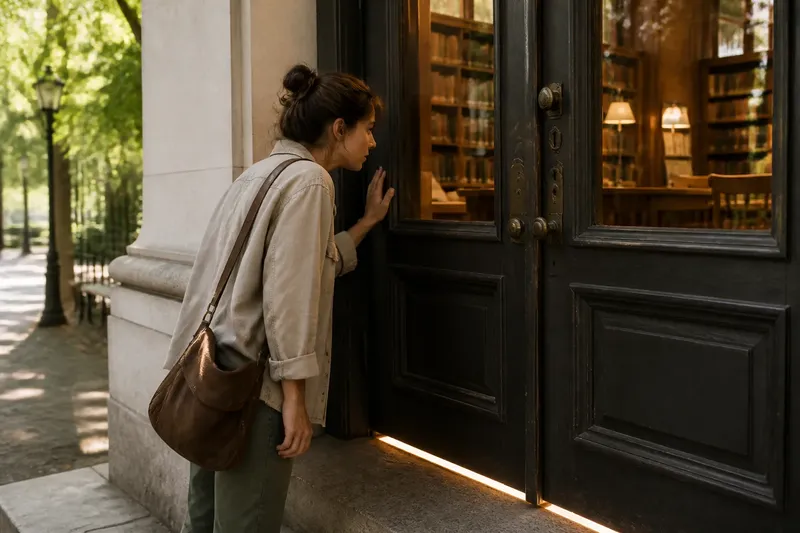
First-person or third-person narration can make the same scene feel like a confession, a careful observation or a mystery. Imagine a character arriving at a locked library door after closing and hearing a sound inside. The events stay fixed; the reader’s access to them changes with the narrator.
Choosing between these viewpoints is less about which pronoun sounds better than about what the story should let readers know, and when. A useful comparison begins with the scene’s limits: who can perceive it, what that person understands, and what remains outside their reach.
First-person narration brings the reader close to one mind
In first person, a character tells the story using “I” or “we”. The reader receives events through that speaker’s perceptions, memories and language. This creates immediate intimacy: a locked door is not merely an object but something the narrator may fear, resent or misunderstand.
That closeness also sets a boundary. Unless the narrator has a way to learn what another character thinks, the story cannot directly report that person’s private thoughts. It can show a clenched hand or a delayed reply, but the narrator must interpret those signs rather than know their meaning.
This limit is useful when uncertainty belongs in the experience of the story. The library visitor might hear a scrape and decide someone is moving a chair. The reader can share that guess without being told whether it is right.
Use first person when the character’s particular way of seeing is part of the subject, not just a convenient route into the scene.
Third-person narration can adjust the distance
Third person refers to characters as “he”, “she” or “they”, but it does not automatically mean the narrator knows everything. In close third person, the narration stays near one character’s perceptions and thoughts while using third-person grammar. The reader may learn that the visitor is ashamed of having forgotten the key, for instance, without hearing the character say “I”.
A more distant third-person voice can describe visible actions without entering anyone’s thoughts. A broader, all-knowing narrator may move among several characters’ private experiences or explain matters no one present could know. These are different choices within third person, not synonyms for the pronoun itself.
That flexibility can help when a story needs to move between perspectives or give readers a wider view. It can also weaken suspense if the narration reveals information that the viewpoint character has not discovered. Decide whose knowledge governs each passage, then keep the reader’s access consistent enough to follow.
Point of view problems usually come from unclear access
Writers often feel that a viewpoint is not working when the real issue is a mismatch between the scene’s intended effect and the information it provides. Look for the symptom, identify what causes it, then try a focused revision rather than changing every pronoun at once.
- The narrator sounds distant. In first person, this can happen when the character reports actions but offers no particular judgement, sensation or attention. Add a selective detail that reveals what this person notices, or consider close third person if the “I” voice feels forced.
- The story explains another character’s private thoughts. A first-person narrator cannot simply know those thoughts. Replace the claim with observable evidence and the narrator’s interpretation, or shift to a third-person viewpoint that can legitimately enter that character’s mind.
- The narration jumps between minds. This often happens when a close third-person passage slips into another character’s unspoken feelings. Keep the scene with one consciousness, mark a clear transition, or choose a deliberately broad narrator whose access is established from the outset.
- The voice feels like the author rather than the character. A narrator may use vocabulary or judgements that do not fit their experience. Rework the phrasing around what this character would recognise, value or avoid saying.
- Suspense disappears too early. The narration may disclose a fact before the viewpoint character could learn it. Hold that information back, or make the wider narrator’s advance knowledge an intentional source of tension.
For a quick diagnosis, underline every sentence that reports a thought or perception and ask whose mind could supply it.
A single scene shows how viewpoint changes the reader’s role
Imagine a character named Mara reaching the locked library door after closing. She hears a scrape inside, sees a thin line of light beneath the door and remembers that she left a notebook on a reading table. This invented situation can be told in either viewpoint without changing those basic events.
In first person, Mara might say: “I heard the scrape and told myself it was a chair. The light beneath the door made me think of my notebook, still on the table.” Her explanation is immediate, but it also exposes her uncertainty. Readers know what she thinks the sound means, not what caused it.
In close third person, the passage might read: “Mara heard a scrape. Probably a chair, she thought. The line of light beneath the door brought the forgotten notebook to mind.” The reader remains near her attention, while the narration has a little more room to shape rhythm and emphasis.
In a more distant third person, the scene could describe the scrape, the light and Mara’s pause without reporting her thoughts. That version asks readers to infer her worry from what she does. A broad narrator could instead reveal that a librarian is inside, but doing so would change the scene from uncertainty about the sound to suspense about what Mara will do.
The practical question is not which version is more vivid in general. Ask whether readers should share Mara’s uncertainty, infer her feelings from outside, or know more than she does.
How do you choose and manage a narrative viewpoint?
Can third person still feel intimate?
Yes. Close third person can stay inside one character’s perceptions and thoughts while retaining “he”, “she” or “they”. Intimacy comes from access to that character’s experience, not from the pronoun alone.
Can first-person narrators be unreliable?
Yes. A narrator may misunderstand events, conceal information or describe them through a strongly limited perspective. Make the gap between their account and the reader’s interpretation legible through details in the scene rather than unexplained contradictions.
Can a story use more than one viewpoint?
Yes, if readers can tell when access changes and whose perspective governs a passage. A clear scene break or chapter change can signal the handover; avoid switching minds within a paragraph unless the narrator is deliberately broad.
How can you test which viewpoint suits a scene?
Draft a short passage in first person and close third person, keeping the actions the same. Compare what each version lets the reader know, what it withholds and whether the character’s voice feels natural.
Choose the viewpoint that gives information its intended weight
To compare first-person or third-person narration, focus on the reader’s position rather than treating one form as automatically closer or more flexible. First person makes a character’s account prominent and limits knowledge to what that narrator can access. Third person can stay just as close, step back to show actions from outside or widen its reach.
Return to the library door and decide what the story needs: Mara’s immediate suspicion, a more restrained view of her behaviour, or information about the room beyond her sight. That choice determines not only how the prose sounds, but which questions the reader is able to ask.
Before revising the whole story, mark the viewpoint in one scene and check each sentence against its source of knowledge. A small, consistent adjustment can make a character’s uncertainty feel deliberate rather than confusing.