The Myth of the One Right Way to Read a Painting
Learn how to read a painting without hunting for one hidden answer, using visible details to build and compare interpretations with care.
How do you read a painting when nobody tells you what it means? The answer is not to guess the hidden message, but to build an interpretation from what the painting actually shows. Learning how to read a painting this way leaves room for more than one thoughtful response, while giving you grounds to question a reading that ignores the evidence.
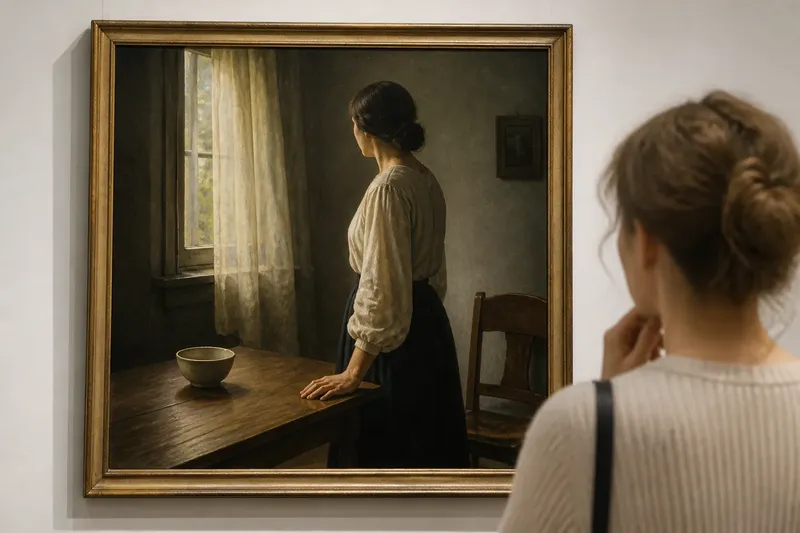
Imagine that you enter a small gallery and stop before an invented painting of a woman beside a table. A bowl sits near the table’s edge; a window behind her is partly covered by a curtain. Her face is turned away, and one hand rests on the tabletop. You feel that the scene is uneasy, but you cannot say why. Nothing on the wall label explains the image.
This invented encounter is a useful case because its details invite several stories. The woman might be waiting for someone, avoiding the viewer, or simply absorbed in a task outside the frame. The question is not which story sounds most dramatic. It is which interpretation accounts for the visible choices, and what remains uncertain.
Begin by separating what you see from what you infer
At first, give the scene a plain description. Name the objects, colours, gestures, positions and relationships you can point to. In this painting, you can say that a figure stands beside a table, that the bowl is close to its edge, and that the curtain partly covers the window. These are observations rather than explanations.
An inference goes further. “The bowl is about to fall” predicts an event. “The woman is anxious” assigns an emotion. Either might be plausible, but neither is directly visible. Keeping the two kinds of statement separate does not make looking cold or mechanical. It shows where your account begins to interpret.
Try describing one feature without giving it a mood. “Her hand presses against the table” is more precise than “She is tense.” You can then ask whether the hand’s position, the figure’s turned head, and the rest of the composition support that feeling.
Keep a small note of observations before writing a full interpretation.
Notice how the painting directs your attention
In the invented gallery scene, the woman’s pale sleeve catches the light, while the bowl and curtain sit in darker passages. The table edge leads the eye towards the bowl, then towards the hand. These choices might make the hand seem important, though emphasis is not the same as a fixed symbol. A highlighted hand can draw attention to a gesture without telling us exactly what the gesture means.
Look at how the parts relate. Is the figure centred or pushed towards an edge? Does the room seem open, or does furniture and shadow compress it? Do the colours repeat across separate objects? Such relationships can support an interpretation more convincingly than a single isolated detail.
Suppose you notice that the woman’s face is turned away. That fact alone does not prove secrecy. If the table, curtain and figure all direct attention away from the viewer, however, you might reasonably describe the scene as withholding information. The observation is still not a verdict about the woman’s character.
Build an interpretation that can explain its evidence
Now consider the first reading: she is waiting for someone. The turned head might suggest that she is listening towards an unseen entrance. The bowl at the table’s edge could imply that a meal or task has been interrupted. But the painting contains no visible doorway in this description, and the bowl’s position could have another purpose. Waiting is a possible account, not a discovery.
A second reading is that she is avoiding the viewer. The turned face supports that possibility, and the partly covered window may make the room feel private. Yet the figure’s hand is on the table rather than raised to shield herself, and there is no clear sign that she has noticed anyone watching. The interpretation has some support, but its emotional claim needs care.
A third reading is that the scene records an ordinary pause. The hand may simply rest on the table; the bowl may be placed there for practical reasons; the curtain may be a feature of the room. This account makes fewer assumptions, though it should still explain why the artist has arranged the objects and light as they appear. Calling a scene ordinary does not make its composition meaningless.
A useful interpretation connects several details without pretending that they settle every question. It should also acknowledge details that do not fit comfortably. If the account depends on a story the painting never gives us, say so.
Compare readings by asking what each one can support
Here is the difference between an open interpretation and an arbitrary guess. “The woman is waiting” is open to consideration because her turned head and the interrupted-looking arrangement might support it. “She has just received bad news from her sister” adds a specific event and relationship that the painting does not establish. The second claim may be imaginable, but imagination alone is not evidence.
Use three questions to assess a reading:
- What visible details support it? Point to particular gestures, colours, objects or spatial relationships.
- What does it leave unexplained? A reading becomes weaker if it relies on one detail while ignoring the rest.
- What would make you revise it? A claim that no possible observation could challenge is not a close reading of the image.
These questions do not produce a score or a single authorised answer. They help you distinguish a response grounded in the painting from a story placed on top of it. Two readers may give different weight to the same detail and still offer considered interpretations.
In the imagined gallery, one visitor might focus on the covered window and find the scene private. Another might attend to the hand and see a pause in a familiar routine. If both can point to what shaped their response, their readings need not cancel each other out.
Ask the questions that sharpen a close reading?
Does a painting have one correct meaning?
Not always. Some images carry clear narrative or cultural clues, but a painting can also leave motives and relationships unresolved. A strong reading explains its evidence and admits where the image remains ambiguous.
Can colour tell me what a figure feels?
Colour can shape mood and direct attention, but it does not work as a universal code. Consider where a colour appears, what it contrasts with, and how it relates to the rest of the composition before assigning it an emotion.
Should I look at the wall label first?
You can look before or after forming an initial response. Looking first on your own can help you notice details without adopting someone else’s framing; reading later may add context that changes how you understand them.
How can I tell interpretation from making things up?
Interpretation links a claim to visible features and remains open to revision. Invention adds particulars that the painting does not support, such as a named relationship or an offstage event, then treats them as facts.
Let context refine the reading without replacing the looking
When a label or catalogue provides information about a painting’s subject, materials or intended setting, treat that information as context rather than a command to stop looking. It may clarify a figure’s clothing or explain an unfamiliar object. It may also invite new questions: does the detail you noticed fit that account, complicate it, or remain unresolved?
Context can alter an interpretation, but it does not make the visible arrangement disappear. In the invented scene, learning that the painting belongs to a series about domestic routines might make an everyday pause more likely. It would not prove that the woman is calm, nor would it erase the way the turned head draws attention away from the viewer.
For a brief worked reading, say: “The figure seems withdrawn because her face is turned away and the window is partly screened. I cannot tell whether she is avoiding someone or concentrating on something outside the frame.” This account names its evidence, states a response and marks the boundary of what can be known from the image.
Leave a little uncertainty in the finished account
Return once more to the bowl, the hand and the curtain. Their arrangement may suggest interruption, privacy or an ordinary pause. The painting does not have to resolve those possibilities for your looking to be precise. You can say which reading currently fits best, identify the details that support it, and leave room for another viewer to notice something you missed.
That is the practical alternative to searching for one right way to read a painting: make claims that the image can carry, and keep the gap between what you see and what you imagine visible. In a gallery, a useful final note might be one unresolved question you can still point back to in the painting.